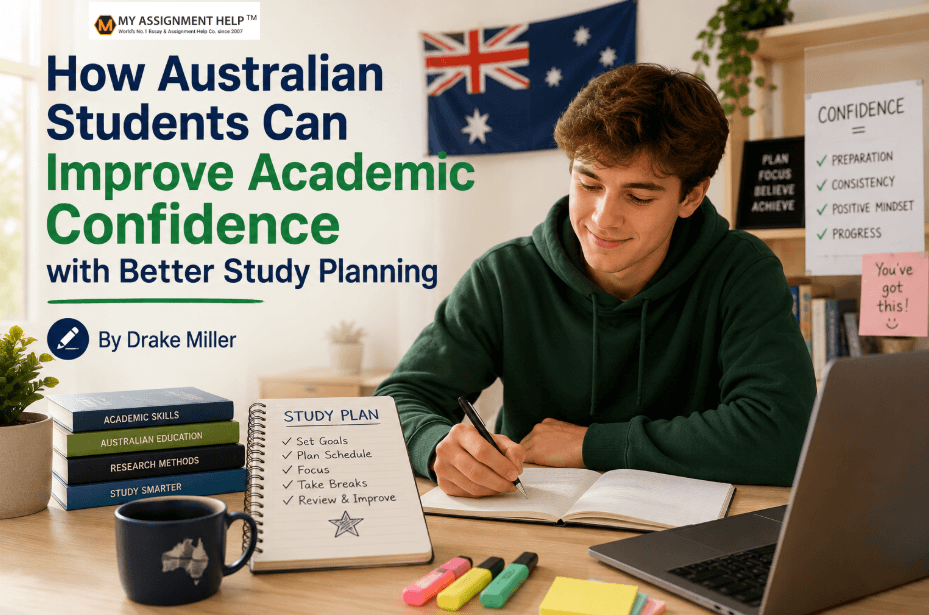
The academic landscape in Australia presents unique, highly demanding structural challenges for students advancing through the critical final years of high school, navigating senior secondary certificates, and transitioning into higher education. Amidst high-stakes examinations, heavily weighted continuous school assessments, complex analytical assignments, and competing extracurricular pressures, a common barrier to student success is not a lack of innate intellectual capability, but a systemic deficiency in academic confidence.
When students feel overwhelmed by a relentless assessment calendar, their perception of their own ability drops. This creates a destructive psychological loop where anxiety paralyzes action, leading to procrastination, poor performance, and further loss of self-belief. To break this cycle, students must understand that academic confidence is not a fixed, genetic trait that some possess and others lack. Instead, it is a malleable psychological state built on structured, strategic action. For Australian students, the most reliable and scientifically proven mechanism to foster this self-belief is the implementation of structured, self-regulated study planning.
The Psychological Link Between Planning and Confidence
Many students fall into a pervasive psychological trap: they believe they need to feel motivated and confident before they can approach a difficult academic task or a complex assignment effectively. However, behavioral science proves that the opposite is true. True academic confidence is an outcome of deliberate, organized action, not a prerequisite for it (Lisá et al., 2023).
Academic confidence is often conceptualized in psychological and educational literature as academic self-efficacy. This refers to an individual’s belief in their capability to successfully execute the specific behaviors required to achieve distinct educational goals (Sander & Sanders, 2006). Educational research consistently demonstrates that this self-belief is one of the most powerful predictors of terminal academic performance. It directly drives active classroom engagement, dictates how long a student will persist through cognitive friction, and acts as a psychological buffer protecting students against chronic stress, anxiety, and eventual academic burnout (Meng & Zhang, 2023).
When a student faces a massive, unstructured curriculum without an explicit, tactical plan, cognitive overload occurs. The working memory becomes severely cluttered with administrative anxiety: “When is this essay due?” “What resource should I open first?” “How will I ever finish this massive syllabus?” This mental clutter depletes the finite cognitive resources available for actual learning, diminishing performance and leading to poor outcomes that ultimately erode the student’s academic self-concept. When structural support is needed to break through this overwhelm, utilizing Myassignmenthelp can provide the external structure required to regain control over a demanding schedule.
By contrast, systematic study planning acts as external cognitive scaffolding. Within the domain of self-regulated learning (SRL), structured planning transforms abstract, intimidating academic demands into concrete, manageable, time-bound goals (Lourenço & Paiva, 2024). According to social cognitive theory, breaking large, complex tasks into actionable sub-goals provides frequent opportunities for “mastery experiences”—small, sequential academic wins that validate a student’s competence and progressively elevate their overall self-efficacy beliefs (Bandura, 1997, as cited in Lisá et al., 2023). As a student’s planning and execution skills increase, their psychological tendency to procrastinate decreases, laying a stable foundation for ongoing, autonomous academic success.
Evidence-Based Productivity Frameworks for High School and University
To cultivate deep, resilient academic confidence, high school and university students need to look beyond generic, color-coded timetables and employ evidence-based productivity methodologies. Integrating structured execution frameworks into a weekly study plan removes tactical ambiguity, optimizes cognitive loading, and builds authentic skill mastery.
1. The Deep Work Framework
Popularized in modern productivity literature, Deep Work involves scheduling distinct, distraction-free blocks of time to focus entirely on cognitively demanding tasks. For senior secondary students tackling complex analytical components—such as advanced mathematical proofs, scientific data analyses, or complex English textual analyses—multitasking is highly detrimental. Minimizing digital interruptions during scheduled study blocks allows the brain to achieve the cognitive depth necessary to synthesize complex material, accelerating the path to genuine mastery.
To implement this effectively, students should aim for “monotasking” periods where social media notifications, phones, and irrelevant tabs are entirely locked down. For an Australian student tackling a heavy workload, setting aside two 90-minute Deep Work blocks per day yields far greater cognitive retention than five hours of fragmented, unfocused studying.
2. The Leitner System
Spaced repetition is the gold standard for moving information from short-term working memory into long-term retention. The Leitner System utilizes flashcards organized into physical or digital boxes based on how well the student knows each item.
Cards reviewed incorrectly move back to Box 1 for daily review, while correct cards move forward to boxes reviewed less frequently (e.g., every three days or once a week). Tracking this physical or digital progression offers visible, undeniable proof of data retention, substantially lowering exam-day anxiety. For subjects packed with dense terminology, such as Year 12 Biology or Legal Studies, this systematic verification provides tangible evidence of progress. When specialized conceptual hurdles arise in these intensive sciences, seeking targeted Biology homework help can clarify complex physiological pathways, turning abstract syllabus requirements into a visible, trackable roadmap of mastery.
3. The Pomodoro Technique
For students struggling with task initiation and the anxiety of starting a massive project, the Pomodoro Technique serves as an excellent operational tool. By breaking study sessions into 25-minute intervals of absolute, uninterrupted focus followed by a 5-minute restorative break, the technique significantly lowers the psychological barrier to entry. Completing four successive “Pomodoros” provides a clear, quantifiable metric of productivity, directly boosting a student’s confidence in their ability to maintain focus. It transforms an intimidating, mountain-sized project into a series of short, surmountable molehills.
4. The Feynman Technique
True confidence stems from deep, structural comprehension rather than superficial, passive memorization. The Feynman Technique requires a student to explain a complex topic in simple terms, as if teaching it to a peer with no prior background in the subject. If the student encounters gaps, hesitation, or friction in their explanation, it reveals exactly where their conceptual understanding falters. Incorporating this active teaching technique into a weekly study plan ensures that exam preparation is active and diagnostic rather than passive. It forces the student to confront what they do not know before they sit in the actual examination hall.
Step-by-Step Guide to Crafting an Effective Study Plan
Building an actionable study plan requires moving past passive scheduling and adopting a goal-oriented, dynamic approach. Australian students can structure their planning process using a clear, four-stage sequential pipeline designed to balance immediacy with long-term retention:
1. Establish S.M.A.R.T. Academic Goals: Prerequisite Phase
Vague ambitions like “I want to study chemistry tonight” offer no objective path to execution. Plans must be Specific, Measurable, Achievable, Relevant, and Time-bound. For example: “I will draft the three body paragraphs for my Modern History essay on the ANZAC legacy between 4:00 PM and 6:00 PM on Tuesday using two primary historical sources.”
2. Reverse-Engineer Assessment Deadlines: Macro-Planning Phase
Rather than tracking deadlines chronologically, students should reverse-engineer them from the final submission date. For a major research assignment, a strategic plan charts milestones backward: Final Polish (Due Date – 2 days), Draft Revision (Due Date – 5 days), First Draft Completion (Due Date – 10 days), and Literature Review & Outline (Due Date – 14 days). This structural breakdown prevents deadline panic.
3. Utilize Time Blocking and Buffer Allocation:Micro-Execution Phase
Traditional to-do lists fail because they do not account for physical time constraints. Time blocking involves assigning specific tasks to distinct hours of the day. Crucially, a realistic schedule must include unallocated “buffer blocks” designed to catch up on tasks that overran their initial estimations due to unexpected complexity.
4. Conduct a Weekly Metacognitive Audit:Optimization Phase
A study plan must function as a flexible, living document. At the conclusion of each week, students should engage in a strategic review by asking themselves self-prompting questions: “What strategies worked well this week?” “Where did I encounter friction?” “How can I adjust my approach next week to improve efficiency?”
See also: Semaglutide Results By Month: Common Questions, Risks, and Better Comparison Criteria
Navigating the Australian Curriculum and External Assessment Pressures
The demand for systematic study planning becomes particularly acute when students encounter the structural realities of senior schooling in Australia. Across different states and territories, the final years of high school require balancing continuous, intensive school-based coursework with comprehensive external examinations. This dual-assessment paradigm creates a relentless pace that can easily overwhelm an unorganized student.
| State / Territory | Senior Secondary Certificate | Assessment Dynamic & Structural Weighting |
| New South Wales | Higher School Certificate (HSC) | Features a split weighting dynamic, typically balancing continuous school-based assessments evenly with rigorous, statewide external examinations at the end of Year 12. |
| Victoria | Victorian Certificate of Education (VCE) | Dominated by continuous School-Assessed Coursework (SACs) and School-Assessed Tasks (SATs) distributed throughout the year, culminating in high-stakes end-of-year exams. |
| Queensland | Queensland Certificate of Education (QCE) | Utilizes a structured system combining highly specific internal assessments (IA1, IA2, IA3) with definitive, syllabus-wide external examinations. |
Without a highly structured study plan, students frequently fall into a reactive cycle, focusing exclusively on the immediate assessment or SAC due that specific week while completely neglecting long-term revision for external exams. To mitigate this, an optimized schedule must divide study time into two distinct categories:
- Current Content Management: Completing immediate homework, synthesizing weekly lectures, and preparing directly for upcoming SACs and internal assessments.
- Retrospective Revision: Utilizing spaced repetition, reviewing past topic notes, and practicing past exam papers under timed conditions to maintain long-term memory retention.
Balancing these dual demands gives students total control over their academic trajectory, ensuring they arrive at their final external exams feeling prepared and confident rather than depleted and anxious.
Overcoming Common Planning Pitfalls
Even with the best strategic intentions, students often encounter predictable setbacks that can derail their routines, cause schedule collapse, and diminish their motivation. Recognizing and actively mitigating these common pitfalls is essential to sustaining long-term consistency.
1. The Planning Fallacy (Over-scheduling)
Ambitious students frequently create hyper-dense timetables that assume peak cognitive performance every single hour, leaving zero room for rest, leisure, or human error. When an inevitable delay occurs—such as a task taking longer than expected—the entire schedule collapses like a house of cards, inducing intense guilt and anxiety. To avoid this, design schedules with realistic expectations, explicitly protecting time for adequate sleep, physical exercise, and social connection.
2. Confusing Passive Review with Active Learning
Spending hours highlighting textbooks, rewriting neat, colorful notes, or simply staring at past papers creates a psychological “illusion of competence.” While these passive activities feel productive and comfortable, they do not challenge the brain, trigger neuroplasticity, or foster authentic mastery. A high-yield study plan prioritizes active retrieval practices, such as flashcard active recall, blitz-writing summaries from memory, or completing practice questions under blind, timed exam conditions.
3. Failure to Seek Timely Academic Support
When a student encounters a highly complex conceptual hurdle—whether it is a difficult calculus proof, an intricate economic model, or a rigorous essay prompt—sticking rigidly to an independent schedule without making progress can damage self-confidence. A central tenet of self-regulated learning is recognizing when independent efforts have encountered a barrier and knowing when to access external support channels (Lourenço & Paiva, 2024).
When independent efforts encounter structural barriers, seeking external guidance is a practical, highly strategic decision rather than a sign of weakness. Utilizing professional educational platforms, such as MyAssignmentServices, allows students to bridge knowledge gaps efficiently, receive constructive feedback on their preparatory work, and master complex academic competencies that are holding them back. Leveraging these specialized resources helps students overcome cognitive roadblocks before they turn into anxiety, keeping their broader study plans on track and preserving their valuable academic momentum.
Strategy Insight: Maximizing Search Visibility for Educational Content
For digital publishers and educational consultants aiming to reach Australian senior high school and university students, creating high-quality content is only half the battle. To ensure these evidence-based strategies rank effectively on search engines, the content must be anchored on a domain that commands strong Topical Authority and Geographic Relevance.
Publishing academic strategy guides on platforms detached from the education niche (such as sports betting or horse racing sites) triggers algorithmic misalignment. Search engine algorithms analyze the contextual ecosystem of a website. When a comprehensive guide on Australian secondary school structures appears on a non-relevant domain, it lacks the topical signals needed to rank for competitive, high-intent localized search queries.
To connect with students looking to balance their continuous school-assessed coursework (SACs) with final external exams, content must be strategically placed on dedicated educational platforms, Australian lifestyle domains, or parenting networks. Aligning high-E-E-A-T authorship with a topically unified digital destination maximizes organic reach, building a trusted gateway where students can find actionable resources to confidently navigate their educational journeys.
Frequently Asked Questions
Q.1 How do I balance immediate SACs or internal assessments while still revising for end-of-year external exams?
The secret lies in a “dual-track” weekly schedule. Allocate roughly 70% of your study blocks to your current week’s demands (homework, assignment drafting, and immediate test prep). Dedicate the remaining 30% strictly to retrospective revision—using active recall and past exam papers to keep earlier topics fresh in your long-term memory.
Q.2 What should I do if my study plan collapses halfway through the week?
Do not try to double your study hours the next day to catch up; this triggers burnout. Instead, look at your pre-allocated “buffer blocks.” Use those unassigned spaces to complete overdue tasks. If you do not have buffer blocks, adjust your schedule moving forward by scaling down less critical tasks. Treat your plan as a flexible blueprint, not an unchangeable script.
Q.3 How many hours a day should a senior Australian high school student actually study?
Quality always beats raw volume. For senior years (Years 11 and 12), targeting 2 to 3 hours of highly focused, distraction-free “Deep Work” on weeknights is far more effective than forcing 5 hours of distracted scrolling with a textbook open. On weekends, 4 to 5 structured hours per day is generally the sustainable limit for maintaining cognitive depth.
Conclusion: Transform Planning into Self-Belief
Academic confidence is not an innate gift possessed by a select few; it is a psychological asset systematically built through structured habits, deliberate practice, and effective time management. For high school and university students across Australia, an organized study plan is the definitive bridge connecting raw ambition to measurable academic success.
By implementing structured frameworks like Deep Work, the Pomodoro Technique, and active recall, and by strategically balancing continuous school assessments with long-term exam preparation, students gain true agency over their education. Ultimately, a well-executed plan does far more than raise grades—it dismantles academic anxiety, reveals true cognitive potential, and instills a deep, enduring confidence that extends well beyond the classroom.
About the Author – Drake Miller
I am an experienced academic blogger at Myassignmenthelp.com, dedicated to creating valuable content for students across different educational levels. My articles focus on assignment assistance, academic planning, research strategies and learning improvement techniques. By delivering practical advice and easy-to-follow guidance, I help students strengthen their academic performance, stay motivated and navigate educational challenges more effectively throughout their learning journey.